How-to Tutorials

Image

Despite the enormous popularity of U.S. News and World Report's college rankings, very few families are aware of how they are developed.

Here are 15 things you should know about U.S. News' college rankings before you put too much stock in them.

1. U. S. news relies on rankings to stay alive.

Despite the fact that the titan of rankings is a mere shadow of what it once was, U.S. News' college rankings are extremely influential. A long time ago, U.S. News struggled to maintain a sufficient number of subscribers.

U.S. News publishes false rankings for all kinds of items, including hospitals, autos, diets, high schools, law firms, holidays, cruises, and health insurance, in order to stay in business.
U.S. News' College Rankings

2. U.S. News’ college rankings have encouraged institutional bad behavior.

One of the main factors for rising college costs and fostering dishonest admission practices is U.S. News' college rating system.

The acts of the audience that cares the most about the data - college presidents and their boards of trustees, and consequently, their admission offices - have negatively impacted millions of students as a result of the rankings race.

These people have a simple (albeit seriously faulty) scorecard provided by US News to gauge how their institutions are doing, and they become upset if their school's rating stagnates or, worse, declines.

3. The college rankings formula can be gamed.

Many universities have discovered the secret to rising through the rankings.
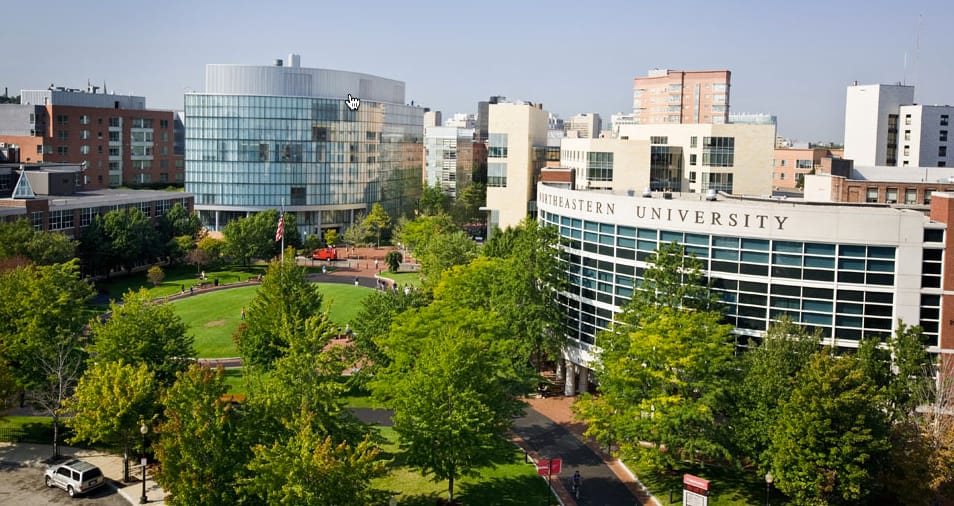
Northeastern University college ranking

One of the universities that worked tirelessly to raise its ranks was Northeastern University. Two decades ago, Northeastern was viewed as a commuter school serving blue-collar students that was saddled with an ugly campus and was of the third tier.

However, a new college president soon took office and became utterly committed to salvaging the organization by doing everything in his power to raise its U.S. News ranking.

There's little doubt that the system encourages gaming, according to the Northeastern president, who was reported as saying this in a Boston Magazine article about this Cinderella story four years ago.

Northeastern, which is currently a very popular destination, is ranked No. 40 in the prestigious national university category by U.S. News. It was ranked No. 162 twenty years ago, and nobody outside of Boston had ever heard of it.

George Washington University's college ranking

Another struggling commuter school, George Washington University, was able to attract wealthy students by cracking the U.S. News college rankings code. These students could afford to pay more for a bachelor's degree, which in turn attracted more well-off youngsters.

Here is a Washington Monthly piece that discusses how ranking manipulation propelled GWU to the top of the list. It is now ranked No. 56 in the category of national universities.

4. Popularity is a big ratings factor.

The U.S. News ranking of a school will be strongly influenced by its reputation among the proper individuals.

Three administrators from the president, provost, and admission offices at each institution in the national university category, for example, are required to evaluate all of their peers on a one-to-five grading scale in yearly surveys. (One is merely minor, while five is exceptional.)

The problem, though, is as follows:

What do the leaders of UCLA, Johns Hopkins, University of Tulsa, and Clemson know about what's happening at Brandeis, Case Western Reserve, Virginia Tech, and Florida State, let alone 300 additional institutions that fall under the national university category?

Or consider colleges that fall under the liberal arts college category but are far less well-known. What information do Beloit and Juniata officials have regarding the caliber of instruction at Lake Forest, Coe, Rhodes, and Allegheny colleges?

Administrators should refuse to rate peers on a scale of one to five since it is an illogical exercise.

5. U. S. News measures six-year graduation rates.

I don’t know any parents who thinks that graduating from college in six years is acceptable. U.S. News, however, uses six-year rates when evaluating schools. Another head scratcher.

6. Rankings encourage colleges to favor affluent students.

Rich students are favored because US News rewards schools that provide higher test scores and grade point averages for their entering freshman cohort.

Wealthy high school students benefit from this selectivity focus because they typically have stronger academic records. These teenagers are more likely to have attended schools with more robust academic programs and can afford pricey test preparation classes. Family income and test scores on standardized tests have a significant positive link.

The school can increase sticker prices without alienating too many prospective consumers by luring wealthier pupils.

7. Rankings encourage the use of merit scholarships.

Prior to the rankings gaining so much attention, wealthy students often had to pay the whole cost of attending college. Most of the funds were set aside for students from middle-class and low-income families who needed financial assistance.

Private and public schools started awarding merit scholarships to recruit brilliant, wealthy students to their campuses rather than those of their rivals as a result of the rankings premium being associated with top students.

How can you come up with the cash to pay for these bargain enticements?

To collect more money for these scholarships, one option is to increase tuition; a second is to decrease financial help for students in need. The majority losers in the rankings game are the low- and middle-income students.

8. Elite schools are the exception to merit awards.

The only universities that don't provide merit scholarships to wealthy applicants are those that occupy the top spots in U.S. News' college rankings.

Rich parents who send their kids to top-ranked universities and liberal arts colleges, like Stanford, Harvard, Princeton, and Amherst, will shell out about $300,000 for a SINGLE bachelor's degree, but they won't do it for other institutions.

Most of these schools admit a pitifully small proportion of low-income students, despite boasting that they reserve their aid for families that need it to send their children to college. Rich pupils are primarily educated at the most exclusive institutions.

9. Rankings encourage admission tricks.

For instance, US News' algorithm favors institutions with a higher student turn-down rate. Schools will pursue students they have no intention of accepting using marketing materials and social media in order to enhance their rejection rates.

Another trick: some institutions make it simple for applicants to submit streamlined online applications, also known as "quick apps" in the business. This tactic is employed by schools to expand their student base and raise their rejection rates.

10. Rankings don’t measure what’s important.

One of the absurd things about the rankings is that producing thoughtful, eloquent young people who can write persuasively and think critically won't move a school up even one point in the rankings. It's odd that U.S. News doesn't even try to gauge the type of learning taking place in classrooms.

The rankings' methodology is actually a set of arbitrary metrics that families and students are intended to use to identify the colleges that are providing the greatest undergraduate education. For determining educational quality, U.S. News uses proxies, although these proxies are at best questionable.

11. Rankings encourage cheating.

Because rankings have become such a high-stakes game, some schools have sent fraudulent information or engaged in unethical behavior. And I have a suspicion that the majority of the institutions distorting their data have never been discovered. Claremont McKenna, the U.S. Naval Academy, Baylor University, and Emory University are some of the institutions that have been revealed.

12. Rankings encourage debt.

The rankings juggernaut's disregard for the amount of student debt accrued in college is extremely vexing. It's a bad oversight, and it's undoubtedly one of the reasons why college costs resist inflation.

US News recognizes colleges that spend lavishly, and the rankings behemoth is unconcerned if this means raising university tuition and forcing students to graduate with huge debt.

Here is an older post I made about this topic for CBS Moneywatch, my former college blog:

Blaming College Rankings for Runaway College Costs

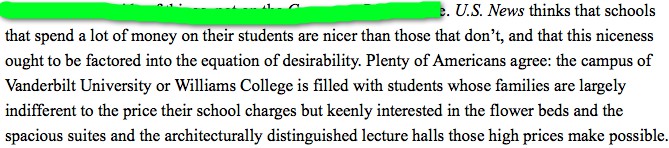
In 2011, Malcolm Gladwell discussed college rankings in a "fascinating essay for The New Yorker" in which he discussed the motivation for colleges to make their campuses into opulent palaces and pass the cost along to the students:
13. Don’t believe the numbers.

You shouldn't think that a college that is ranked No. 1, No. 19, or No. 73 is superior to peers that are ranked No. 6, No. 42, or No. 95. I've witnessed far too many parents make exorbitant financial sacrifices for their children's attendance at rankings darlings when it was totally unnecessary to do so.

What a pupil does no matter where he or she ends up is more significant than the school that person attends. This fact is demonstrated in a "Post About My Daughter" I wrote four years ago.

14. Use U.S. News as a tip sheet.

Use the U.S. News rankings to come up with concepts rather than just concentrating on the numbers. This will be especially useful when looking for prospective institutions outside the national university category, which comprises almost all of the top universities in the country.

Try exploring for inspiration in the regional universities and liberal arts colleges categories of U.S. News before beginning your investigation.

15. U.S. News is here to stay

During a press conference a few years back, U.S. News editor Brian Kelly pledged the following:  “You can love us or hate us, but we’re not going away.”


A multi-ethnic group of school children are indoors in a classroom. They are wearing casual clothing. They are sitting on the floor and eagerly listening to their teacher read a storybook.

A major benefit of smaller class sizes is students typically receive additional attention.(GETTY IMAGES)

It has long been advocated that smaller class sizes will boost student performance.

Supporters, which include many parents and instructors, contend that smaller classrooms allow for more individualized attention for each student, which boosts test scores, grades, and behavior problems. However, opponents of class-size reduction initiatives contend that such changes just divert funds from other priorities without significantly improving students' academic performance.

“No one’s going to argue against the substantive argument for reducing class sizes, right?” says Douglas Ready, a public policy and education professor at Columbia University in New York. “It sounds great. Teachers want it. Parents want it. Everybody wants it. The issue is paying for it and finding teachers to do it.”

Benefits and Challenges of Smaller Classes

According to Ready, there have been sizable, randomized control trials, which are typically regarded as the gold standard in study design, looking at the impacts of class-size reduction. These research discovered a link between reduced class sizes and higher test scores.

The Student/Teacher Achievement Ratio (STAR) project, a Tennessee experiment, began in 1985. It placed 7,000 kindergarten students in 79 schools in classrooms of varied sizes.

According to a report on the study published in the scholarly journal Teachers College Record, after four years, the students who had been assigned to small courses were between two and five months ahead of their counterparts in bigger classes. The smaller group pupils continued to gain advantages even after the trial was over and the students were placed back in regular classroom settings. They nearly had a full school year on their classmates by the seventh grade.

Then, in 1996, Wisconsin carried out a related study comparing adolescents in classes of 12 to 15 kids with those in classes of 21 to 25 students, with a focus on schools serving low-income students. Again, a federal review of the study found that kids in smaller classes performed better on tests.

“The research is crystal clear that smaller classes lead to better student outcomes in every single way that can be measured,” says Leonie Haimson, executive director of the nonprofit organization Class Size Matters, which promotes smaller class sizes.

However, the outcomes of more recent research utilizing various methodologies have proved conflicting.

For one, reducing class sizes means hiring more teachers, which has long been a challenge for districts, Ready says.

Many of the increases in test scores, according to a study of class-size reduction in New York City public schools from 2009 to 2013, were countered by reductions brought on by the "new teacher effect." According to the paper, class size reduction can "significantly boost student achievement," but only if schools can accomplish it without jeopardizing the caliber of their teachers.

California started a program in 1996 to decrease class sizes by giving districts $650 for each pupil in kindergarten through third-grade classes with 20 or fewer children. Approximately 30,000 new teachers were promptly employed by districts, but the program cost the state billions of dollars.

Inexperienced and uncertified teachers made up a large portion of those educators, according to a report from the Public Policy Institute of California. And in schools with a high percentage of low-income pupils, where nearly 25% of students had a teacher with two years of experience or less and 30% had a teacher who was not fully credentialed, the issue was particularly serious for Black students. Only 12% of white pupils at schools with fewer impoverished students had a teacher with two years or less of experience, and only 5% had a teacher with incomplete credentials.

However, a review of studies on the class size reduction initiative reveals that it “had a positive and significant influence on student achievement,” according to a Princeton University researcher. “Black students seem to have benefited” from class-size reduction “more than any other racial or ethnic group.”

Alternatives to Reducing Class Size

Some education experts contend that raising teacher wages would be a better use of the millions of dollars needed to fund widespread attempts to reduce class sizes, “thus increasing the size (and arguably the quality) of the teacher labor pool,” Ready wrote in a report.

Even while experts dispute reports of a statewide teacher shortage, many school districts have had trouble filling positions because of the pandemic. Federal data show that in January 2022, 44% of public schools reported having at least one vacancy, and 61% attributed the rise in teacher and staff vacancies to the COVID-19 pandemic.

Over the years, fewer individuals have chosen to pursue careers as teachers. According to the American Association of Colleges for Teacher Education, there were more than 200,000 undergraduate education degrees given each year in the 1970s, but less than 90,000 were awarded in 2018.

“We are in a moment of extreme teacher shortage, and it’s likely to get worse,” According to Bryan Hassel, co-president of the education advocacy organization Public Impact. “The idea that we would say now in that environment, ‘You need to find and keep another 25, 30, 40% more teachers,’ is a recipe for disaster because who’s going to fill those slots?”

Instead, states and school districts should try to increase their capacity for small-group tutoring by hiring paraprofessionals, such as teaching assistants, Hassel argues.

“There is strong evidence that having small groups learn from a teacher or a paraprofessional in a tutoring setting is very effective,” Hassel says. “Schools really should be trying to increase the amount of that that goes on, but that can happen in a larger class. You can have 25 kids in a room. Some are working intensively in a tutoring environment with the teacher; the others are doing projects, doing other work.”

What Parents Can Do

Haimson advises parents to talk to political authorities, school board members, and principals about studies showing the advantages of smaller classes.

“Whether you're talking about academic achievement or social, emotional recovery from the pandemic, the best way to ensure that happens for all kids is to be able to offer them small classes,” she says. “We hope that parents will act as their children's advocates and push for that at the local level.”

In the meantime, Ready advises parents to concentrate on teacher quality.

“If a district can afford to have smaller class sizes and maintain teacher quality, great," he says. "But in most parts of the U.S., there are trade-offs."

Ask the instructor or other school personnel if you have questions about your child being in a large class "what plans they have to ensure that kids are getting individual attention even though the class is large, such as small-group work within the large class" or having more paraprofessionals, Hassel says.

"The value of small classes likely comes from the extra attention students get," he notes, "and so there are other ways to get students that attention if you're stuck with a large class."


It's common to believe that you could be doing more to improve yourself. But being too harsh on yourself won't help you become a better person. In actuality, the reverse is true.

Your capacity to treat those around you with kindness and compassion will increase the more self-kindness and self-compassion you can cultivate. Additionally, helping others might give your life a deeper sense of purpose. Even your physical and emotional health may benefit from it.

Here are some suggestions for incorporating self-improvement into your everyday routine and letting go of self-critical ideas.

You've undoubtedly heard it a million times, but maintaining a gratitude journal of your blessings can significantly change your outlook. According to research, practicing thankfulness every day can reduce stress, enhance sleep quality, and foster happier interpersonal relationships.

If you're having trouble figuring out what you should be thankful for, Anna Hennings, MA, a mental performance coach in sport psychology, suggests utilizing the acronym GIFT.

GIFT TECHNIQUE

In your list of things to be thankful for, search for examples of:

  • Growth: personal growth, like learning a new skill
  • Inspiration: moments or things that inspired you
  • Friends/family: people who enrich your life
  • Tranquility: the small, in-between moments, such as enjoying a cup of coffee or a good book
  • Surprise: the unexpected or a nice favor

Hennings advises including the reason for your gratitude together with the items you're glad for.

Make an effort to notice individuals around you when you see them, advises psychologist Madeleine Mason Roantree. This might be done in a variety of ways, such as nodding or smiling to strangers passing by or greeting everyone who enters the workplace.

By doing this, even if you don't have a deep relationship with someone, you can notice that you feel more present and connected to others around you.

Even a little period of electronic abstinence can be good to your health. Take a break from your phone for a few hours the next time you have nothing to do.

Instead, consider taking a walk and getting in touch with your ideas.

Take a break from your phone, whether it be for a few hours or the full day. Try going outside to connect with nature or meeting up with friends in person as an alternative. Keep in mind that even a brief vacation from your phone might help you relax and concentrate on what makes you happy.

It's simple to get sucked into being too critical of your perceived flaws and harsh with yourself. Hennings claims that this destructive self-talk can reduce our motivation in general.

It can be challenging to find motivation to move toward self-improvement if, for example, you frequently remind yourself that you aren't a decent person.

Declare a fact and then be optimistic to practice positive self-talk.

FACTS + OPTIMISM = POSITIVITY

The next time you find yourself feeling incompetent or overwhelmed, try telling yourself:

“I know this change is going to be challenging, but I’ve put a lot of meaningful thought into it and have considered all the options open to me [fact], so I feel confident I am doing the best I can in this moment [optimism].”

The difficult part is recognizing when you are thinking negatively and consciously choosing to change your perspective. However, with enough practice, this will get simpler.

Giving others the benefit of the doubt can help you feel more purposeful and less alone.

Try to be kind to someone you don't know:

  • Give a complete stranger a compliment.
  • Purchase lunch for your coworker.
  • Send a friend a card.
  • Give to someone who is in need.

“You’ll notice your mood lift a little when you do good for the sheer joy of it,” says Roantree. According to studies, merely keeping track of acts of kindness for a week can increase gratitude and happiness.

It's easy to eat your food quickly without paying attention to your body when you're caught up in the middle of a busy day.

You can check in with both your physical and emotional well-being when you eat mindfully.

Take your time eating a meal, even if it's simply a sandwich. Take note of the various flavors and textures. “It’s a type of mini meditation that can act as a simple ‘de-stressor,’” says Roantree.

You may feel grouchy and unproductive throughout the day if you are not properly slept. Sleep for seven to eight hours every night.

Reduce your coffee intake in the afternoon, take a melatonin pill, or unwind in a warm bath or shower before bed to find strategies to increase the quality of your sleep.

Spend a moment concentrating on your breathing before drifting off to sleep, waiting in line for the bus, or at the grocery store. Deep breathing exercises have been demonstrated to boost our bodies' natural relaxation response and manage stress, even for a few minutes a day.

DEEP BREATHING 101

Roantree suggests trying the following technique:

  • As you typically would, inhale.
  • Make sure your exhalation is longer than your inhalation.
  • Continue doing this until you begin to unwind. If you want to count, try inhaling for four counts, holding for seven, and then expelling for eight.

Whether you have a relaxing or stressful day at home depends on how you feel about it.

Set a timer for 30 minutes the next time you have some free time, then complete a few small housekeeping tasks to brighten your day, like:

  • sanitizing the bathroom mirror.
  • putting up that beloved photograph you've been meaning to show.
  • arranging your workspace.

Spend some time relaxing in your newly cleaned environment as a reward for yourself; apply a face mask, for example, in the bathroom.

Holding on to regret, sadness, and hatred affects others. You are also hurt by it. Any of these feelings will have an impact on your mood and how you treat everyone, including yourself.

“Harboring unforgiveness breads negative thoughts,” says Catherine Jackson, a licensed clinical psychologist and neurotherapist. “Decide to let it go and make a plan to never go to bed angry.”

Self-care is frequently associated with manicures and spa visits (which are all great ways to destress). Jackson, though, asserts that regular self-care goes far beyond pampering. “It’s also about eating well and getting enough nutrition to support your brain and body,” she explains.

Similar to this, make sure you're moving your body mindfully or exercising, spending time with people, and relaxing or taking some time off for yourself.

These don't have to take a lot of time. Find brief 10- or 20-minute periods of time during the day to go for a walk outside or to make yourself a bowl of fresh fruit.

Many of us have the propensity to dwell on what has been said to us and frequently replay it in our minds. Jackson advises extending empathy and understanding to the other person as well as to ourselves, as opposed to taking things personally and being judgmental of oneself.

Consider all the ways you influence others for the better, and attempt to list them in a journal every day. Again, these need not be elaborate displays.

Perhaps you held the door open for a person hauling a few large suitcases. Or, when you saw the coffee was running low at work, you started preparing a fresh pot.

If you find you’re still struggling to change your frame of mind, Jackson advises to think of it this way: “Tomorrow is a new day, so if you beat yourself up today about something, let yourself off the hook and start fresh tomorrow.”

BE YOUR OWN BEST FRIEND

Try to treat yourself the same way you would a loved one. Would you constantly talk down to your best friend if they had an “off” day and dropped the ball on something?

Hopefully not. And you shouldn’t talk to yourself that way, either.

It's common to grow preoccupied with striving to improve oneself. However, the first step in becoming a better person is to treat yourself with the same loving care that you do other people.

This entails being gentle with yourself when you fall short of your goals and being kind to yourself when you're having a terrible day.

Remember that there are several strategies to improve oneself; the ones listed here are but a handful. Try to incorporate the things that make you feel the happiest and most nurturing into your daily life.


One of the purest institutions and bonds between two people is marriage. People take vows for a purpose, and it is up to you to make sure you honor each one of them. Although it is true that marriages are made in heaven, things aren't always as they seem. You will fight, argue, and argue a lot on this roller coaster journey. There will be times when you want to kill your husband because he is so annoying. What is most impressive about all of this is how you two have survived it all and are still in love with one another. You two need to stick together while doing this. You can keep up a healthy relationship with your husband with only a little bit of understanding, a lot of patience, and some deliberate efforts.

And if, after all these years or if you're a newlywed lady, you're still unsure about the various ways to keep a strong connection with your husband, then you should be here. We will provide you with some practical advice that is sure to work.

1. Be a good listener

husband wife

Sit your spouse down and ask him to tell you about his day if you see he is stressed when he gets home from a long day at work. Avoid agitating him with your own complaints and resentments because doing so will just make him feel worse. Help him relax by being a good listener.

2. Spend good time with your husband

husband wife cooking

It's crucial to do this, yet most couples frequently overlook it. Making ensuring you spend quality time with your hubby is important. You both need to take some time for yourselves, despite how busy you are and what happens. Talk to each other, go on dates, and generally act like a couple.

3. Honesty should be maintained

You need to make sure that there is honesty in all situations. Just avoid lying about anything because once you have, the temptation to lie more frequently will be there. Your honesty will be greatly appreciated by your husband, we are confident.

4. Sometimes let go

Your husband may argue with you at times even when it wasn't your fault. To occasionally let go of such things in the name of love is acceptable. Just nod your head in agreement and carry on. However, refrain from doing this all the time lest he begin to take you for granted.

5. Never raise your voice when angry

wife shouting at husband

As we previously stated, arguments and disagreements are rather common in all relationships. Never raise your voice or yell at your husband, though. His macho ego might take a hit from this, and before you know it, things might grow worse. If you have a concern, alert him to it in a tactful yet firm manner.

6. Rekindle the lost spark and romance

husband wife date

The most crucial action is to maintain a healthy and active relationship. Some couples simply grow accustomed to their daily routine as the years go by and don't change anything. Rekindle your romance by taking him out on dates, surprising him, sending him flowers, cooking him a dinner, and so forth.


It can be challenging to bear in mind how to emphasize your body type when wearing oneself in clothing that fits properly. How does the regal-looking red shirt with the design seem when worn? Finding clothing you enjoy can be difficult enough, but when it doesn't exactly fit the way you want it to, you start to question your shape and your physical makeup. Everyone has a diverse and unique figure, thus your body type shouldn't prevent you from upgrading your style.

Instead, mastering how to draw attention to the essential qualities of your build will help you feel confident wearing clothing that highlights your greatest attributes while also keeping you looking stylish. Man of Many is your one-stop resource for advice on how to dress for your body shape, recognizing a range of body types, emphasizing the importance of tailoring, and dressing for the body you already have.

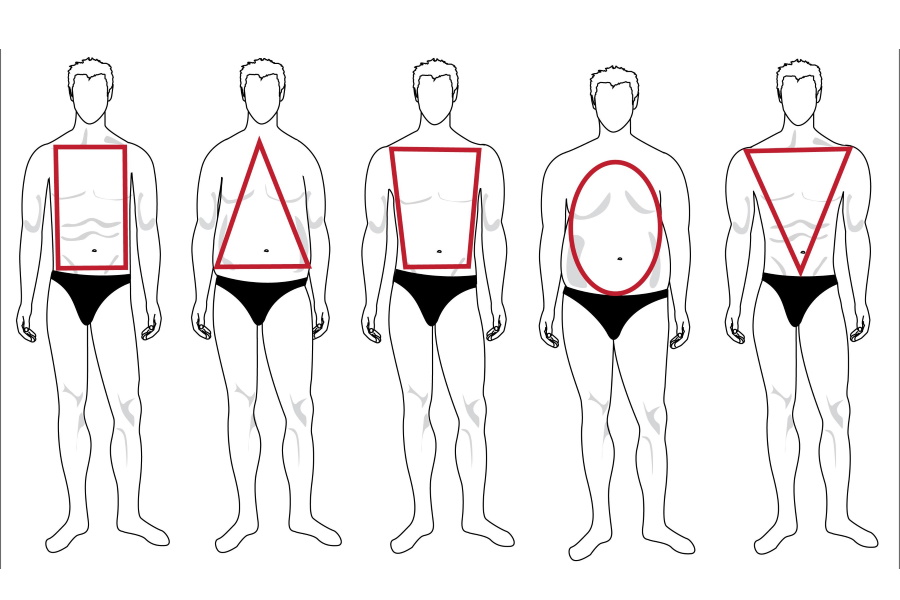
5 Types of Male Body Shapes

There are many different male body forms, none of which are the identical, but these are the ones that are most frequently used to define various physical features.

1. Oval Body Shape

The oval body type is popular among men and is characterized by narrow shoulders, chest, broader waist, and slim hips. You should concentrate on purchasing items with darker tones or vertical stripes because the focus on ovals aims to minimize the appearance of the waist area. To get a slimmer appearance, you can also pair these hues with custom-made pants.


2. Rectangle Body Shape

In general, the proportions between the waist and hips on rectangles are ideal. This body type can experiment with prints and patterns and is frequently simple to work with. Vertical stripes, however, should be avoided since they can accentuate your existing rectangular design.


3. Triangle Body Shape

The waist is wider in the triangular form, which resembles an oval. Consider the use of dark hues carefully, attempt to emphasise your upper body, and narrow down your lower body because the shoulder area is much more thin.

Contact Form

Name Email * Message *

Menu Halaman Statis

Popular Posts

8 Facts About Rebecca Ferguson | Model Kebaya Terbaru | Les Meilleures Pages à Colorier